


















Comments on Otherwise similar functions with opposite parity, were they considered, are they useful? Case of polynomials
Post
Otherwise similar functions with opposite parity, were they considered, are they useful? Case of polynomials
So, can we transform an even function into an odd function and vice versa? Let's consider this method:
Transformation even->odd:
Suppose $f_{even}(x)$ is a function which satisfies the following condition:
$$f_{even}(x)=\sum_{k=0}^\infty G(2k)\frac{x^{2k}}{(2k)!}$$Where the coefficient function $G^*(x)=G(2s)$ is equal to its Newton series expansion:
$$G^*(s) = \sum_{k=0}^\infty \binom{s}k \Delta_s^k G^* \left (0\right)$$What we are doing here, is Newtonian interpolation of consecutive derivatives over even points so to get the values at odd points.
The function $f_{even}(x)$ is evidently even. Now the operator
$$\operatorname{oddify} f_{even}(x)=\sum_{k=0}^\infty G(2k+1)\frac{x^{2k+1}}{(2k+1)!}$$transforms an even function to an odd counterpart. The operator is linear.
The opposite process is similar, for odd function:
$$f_{odd}(x)=\sum_{k=0}^\infty G(2k+1)\frac{x^{2k+1}}{(2k+1)!}$$and $G^*(s)=G(2s+1)$, satisfying the same Newton series condition,
the following operator gives an even counterpart:
$$\operatorname{evenize} f_{odd}(x)=\sum_{k=0}^\infty G(2k)\frac{x^{2k}}{(2k)!}$$Examples.
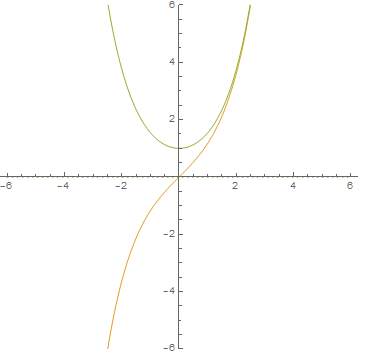
$f_{even}(x)=\cosh x$;
$f_{odd}(x)=\sinh x$;
$G(s)=1$
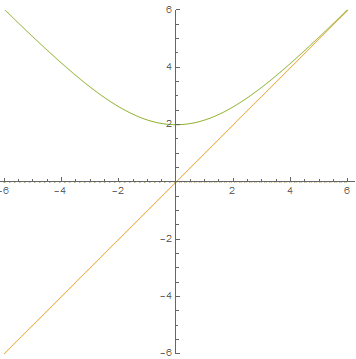
$f_{even}(x)=x \coth \left(\frac{x}{2}\right)$
$f_{odd}(x)=x$
$G(s)=-2s\zeta(1-s,1)=2 B_s(1)$
$f_{even}(x)=\csc ^2(x)-\frac{1}{x^2}$
$f_{odd}(x)=\frac{\psi ^{(1)}\left(1-\frac{x}{\pi }\right)}{\pi ^2}-\frac{\psi ^{(1)}\left(\frac{x}{\pi }+1\right)}{\pi ^2}$
$G(s)=\frac{2 (-1)^s \psi ^{(s+1)}(1)}{ \pi ^{s+2}}$
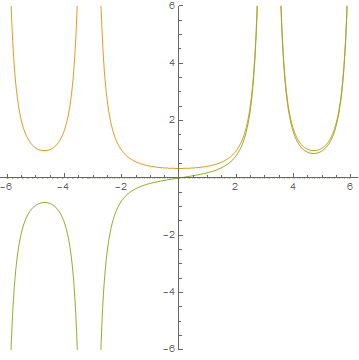
What one can notice in these examples is that one counterpart function can be much more complicated than the other, even one can be elementary while the other is not.
Regarding the second example. Obviously, the method cannot work into the direction from $f(x)=x$. First thought I had when thinking about an even counterpart of this function was "what function can have non-zero even values while all dd values except at 1 equal to zero?@, and, oops, the obvious solution is Bernoulli numbers (in this case, $B_n(1)$ so to be equal to Newton's expansion).
Now, can we find the counterparts to polynomials? For some, yes! We just have to integrate the solution for $f(x)=x$. We also divide the result by 2 so to make a better plot.
$f_{even}=\frac{x^2}{4}+\frac{\pi^2}6$
$f_{odd}=\text{Li}_2\left(e^x\right)+ x \log \left(1-e^x\right)-\left(\frac{x^2}{4}+\frac{\pi ^2}{6}\right)$
$G(s)=B_{s-1}(1)$
(here, Bernoulli polynomials of negative order should be understood as their generalization via Hurwitz Zeta)
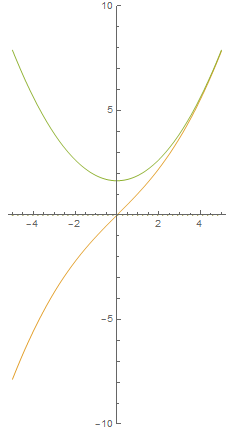
$f_{even}=2 \text{Li}_3\left(e^x\right)-x \text{Li}_2\left(e^x\right)-\left(\frac{x^3}{12}+\frac{\pi ^2 x}{6}\right)$
$f_{odd}=\frac{x^3}{12}+\frac{\pi ^2 x}{6}$
$G(s)=B_{s-2}(1)$
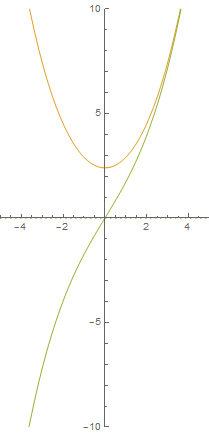
And so on. The both functions are infinitely differentiable, so this gives us a family of functions, asymptotically equal to the polynomials, but with the opposite parity.
The pairs of "polynomials" can be constructed this way:
$$f_n(x)=(n-1)\operatorname{Li}_n\left(e^x\right)-x\operatorname{Li}_{n-1}\left(e^x\right)$$$$feven_n(x)=\frac{f(x)+f(-x)}2$$$$fodd_n(x)=\frac{f(x)-f(-x)}2$$At even $n$ the even part is polynomial, the odd part is "pseudo-polynomial", at odd $n$ the even part is pseudo-polynomial, the odd part is polynomial.
Via differentiation we can also construct an odd counterpart of constant function:
$f_{even}=1$
$f_{odd}=\frac{\sinh (x)-x}{\cosh (x)-1}$
$G(s)=2 B_{s+1}(1)$
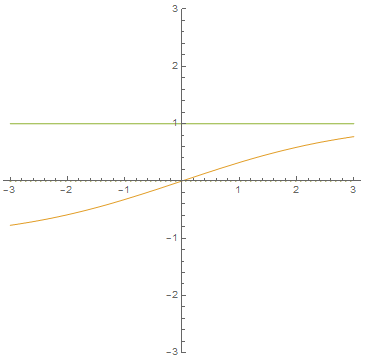
That said, I wonder whether anyone ever considered this family of functions that asymptotically behave as polynomial, but have opposite parity.
Would not it be cool (and applicable in technology) to have an analytic function that behaves as $x^2$ but is odd?
Why such function counterparts are so much more complicated than the original functions?
This question on Stackexchange


1 comment thread