Communities

Writing
Writing
Codidact Meta
Codidact Meta
The Great Outdoors
The Great Outdoors
Photography & Video
Photography & Video
Scientific Speculation
Cooking
Cooking
Electrical Engineering
Judaism
Judaism
Languages & Linguistics
Software Development
Mathematics
Mathematics
Christianity
Christianity
Code Golf
Code Golf
Music
Music
Physics
Physics
Linux Systems
Linux Systems
Power Users
Power Users
Tabletop RPGs
Tabletop RPGs
Community Proposals
Community Proposals
tag:snake search within a tag
answers:0 unanswered questions
user:xxxx search by author id
score:0.5 posts with 0.5+ score
"snake oil" exact phrase
votes:4 posts with 4+ votes
created:<1w created < 1 week ago
post_type:xxxx type of post
Search help
Notifications
Mark all as read See all your notifications »
Q&A

Comments on With what classes of functions does the equality $\int_0^\infty f(x)dx=\int_0^\infty\mathcal{L}_t[t f(t)](x) dx$ lead to paradoxes?

Post

With what classes of functions does the equality $\int_0^\infty f(x)dx=\int_0^\infty\mathcal{L}_tt f(t) dx$ lead to paradoxes?

+0
−1

The following operators keep the area under the convergent integrals unchanged:

$$\int_0^\infty f(x)\,dx=\int_0^\infty\mathcal{L}_t[t f(t)](x) \, dx=\int_0^\infty\frac1x\mathcal{L}^{-1}_t[ f(t)](x)\,dx$$

But with divergent integrals applying the Laplace-based transform $\mathcal{L}_t[t f(t)](x)$ (I would denote it $\mathcal{T}f(x)$) to a function more than once may lead to a strictly greater or smaller function, which I refer to as an unacceptable paradox.

One such example is the function $f(x)=\frac1{\sqrt{x}}$. Applying the transform $\mathcal{T}$ to it twice, one arrives at function $\frac{\pi }{2 \sqrt{x}}$, which is strictly greater than the original function, and the problematic step seems to be the first one. It seems, one class of the problematic functions is $f(x)=\frac1{x^p}$, where $ 0< p< 1$.

So, I wonder, what is the whole description of the class of the functions that lead to such paradoxes. I outline the two paradoxes I am seeking to avoid:

  1. Functions such that $f(x)>\mathcal{T^n}[f(x)]$ or $f(x)<\mathcal{T^n}[f(x)]$ for all $x>0$, that is the function becomes strictly smaller or greater after the transform.

  2. Functions such that the integral $\int_0^\infty (f(x)-\mathcal{T^n}[f(x)])dx$ is finite but nonzero.

Is it possible to clearly describe the class of functions that lead to such paradoxes so to avoid them?

History

3 comment threads

x-post https://math.stackexchange.com/questions/4768302/with-what-classes-of-functions-the-equality-i... (1 comment)
Why "paradox"? (6 comments)
"applying $\mathcal{T}$ more than once"—what if we apply $\mathcal{T}$ only once? (5 comments)
"applying $\mathcal{T}$ more than once"—what if we apply $\mathcal{T}$ only once?
clemens‭ wrote 4 months ago

You say that $\mathcal{T}^n(f)$ may be strictly greater than $f$. Do you know if this is true only for $n≥2$, or might it also be true for $n=1$?

Anixx‭ wrote 4 months ago · edited 4 months ago

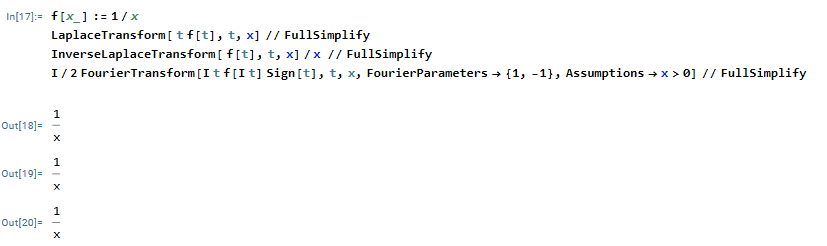
I did not enocounter with such examples. It seems we can apply the transform to $f(x)=\frac1{\sqrt{x}}$ once, and there are no paradoxes, but if we apply it twice we get the original function but changed by a factor $\pi/2$. Maybe, the formula should be chaged to introduce some factor? I do not know, but in other cases the formula works precisely, for instance makes $1/x$ into $1/x$ and $1$ into $1/x^2$ (which is supported by the theory of hyperfunctions).

clemens‭ wrote 4 months ago

@Anixx: Very interesting. It looks to me that $\mathcal{T} f$ where $f(x) := \frac1x$ is $\frac1{x^2}$, though—am I interpreting $\mathcal{T}$ wrong?

Anixx‭ wrote 4 months ago · edited 4 months ago

Maybe, wrongly. This is the Mathematica code: https://cdn.phototourl.com/free/2026-05-11-65dfdc4d-558d-4c0d-ad0c-d9ade4567d35.png First is forward transform, then backward transform, then again forward with another method. See also this post: https://math.stackexchange.com/a/4802878/2513

clemens‭ wrote 4 months ago

You are right, $\mathcal{T}_x \frac1x$ is indeed $\frac1x$. I made a mistake.